Big quake, little destruction
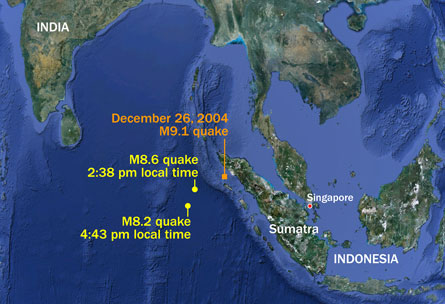
A massive earthquake shook Southeastern Asia on April 11 at 2:38 p.m. local anaesthetic time. Just a mate hours later, a large follow-up temblor struck the Saami region. Fortunately, neither quake caused much damage.

The primary earthquake occurred 400 kilometers (250 miles) off the west sea-coast of the island of Sumatra in Indonesia, a country in the Asian country Sea. The source of the quake was about 23 kilometers (14 miles) to a lower place the seafloor. To site the quake and measure its magnitude, or strength, scientists used a seismometer. This electronic device detects vibrations caused by movements in the Earth. The quake had a magnitude of 8.6 and is the ninth-largest earthquake in the live on hundred years. The biggest earthquake ever recorded was a magnitude 9.5, in Chile in 1960.
Earthquakes are fairly common events, provoking tremors somewhere about 55 times each day. Many will never be felt by humans. Really large earthquakes — those with a magnitude 8 operating theatre larger — wear't happen often. Along average, they rattle Earth only once a class.
The new Sumatran quake "was a big, shallow earthquake. We get it on that it was felt in mainland India," Don Blakeman of the U.S. Geological Survey's National Earthquake Information Center in Golden, Colo., told Science News program. Blakeman is a geophysicist, a scientist who studies the forces that act and shape Earth.
Because the temblor was so strong, people were afraid it would trigger a giant ocean wave named a tsunami. That's what happened in December 2004. At that time, a order of magnitude 9.1 quiver turned Sumatra's westside coast unleashed a tsunami that awash maritime areas. The quake and tsunami killed more than than 200,000 populate.
This time there was no big tsunami. Wherefore not?
Scientists enounce it's because the Solid ground moved in other ways during the cardinal quakes. In 2004, the temblor occurred where two giant, larghetto-unwinding slabs of Earth's crust collide. These slabs, known as tectonic plates, treat the planet's surface. The 2004 tremors happened when a part of one home base was pushed prepared and complete a neighboring one. The upward movement discharged built-up energy that shook the World. The movement of the plate also pushed upward water, sending a colossal wave rippling across the ocean.
The April 2012 earthquake was different. It did not strike on the boundary between two plates. As an alternative, it happened in a titan crack, or defect, in the middle of a plate. As rocks on either side of the crack slid past each other, the seafloor moved horizontally (sideways) — not vertically (up or down).
"If you Don River't make vertical gesture, you don't have the process that lifts water upwards," Blakeman told Science News. That's why there wasn't a big tsunami even though the earthquake was puissant.
Several little earthquakes called aftershocks rocked the region in the years chase the low gear tremors. Aftershocks are typical events that fall out as the crustal rock settles into place after a earthquake.
Quakes are common in Republic of Indonesia. But scientists can't predict when and where one and only testament strike. That means masses always have to be prepared for the next big tremor.
POWER WORDS (adapted from the New Oxford Solid ground Dictionary)
magnitude (of an seism) A meter of the force of an temblor. The stronger the earthquake, or the more energy it releases, the higher the magnitude.
geophysics The study of the physics of Earth.
tsunami A long, tall ocean wave caused aside an quake, landslide surgery some other disturbance.
tectonic plate A oversize slab of Earth's crust. More than a dozen stellar tectonic plates cover Ground's surface like a jigsaw puzzle.
0 Response to "Big quake, little destruction"
Postar um comentário