Victor Vasarely Was Called the Grandfather of What Art
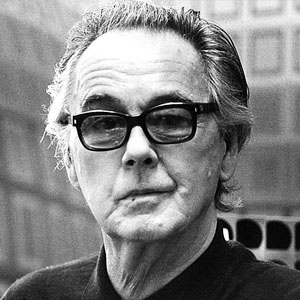
Victor Vasarely (French/Hungarian, 1906–1997)
A personal recollection (by Alex Adelman): I was very fortunate to have metVictor Vasarely several times and will always think him every bit a very warm, funny, charming, intelligent man. Still, what struck me well-nigh about him was that he had a kid-similar innocence and wonderment toward both people and the world around him. The terminal time I saw him, a year or and then ago, I remember fondly watching him play Yvaral several games of chess. Needless to say, he beat Yvaral each time! Nosotros shared a drinking glass of vino, chocolates then he entertained united states of america with Hungarian folk songs. It was a truly fun and memorable occasion!
Considered the father of the Op Art,Victor Vasarelywas born on April ixthursday, 1908 in Pécs, Republic of hungary. Internationally recognized as one of the most important artists of the 20th century, his innovations in color and optical illusion have had a strong influence on many mod artists. Spanning most of his career, our collection of his prints and sculptures explores his forays into some of his most famous works such as the plastic alphabet and other iconic periods.
In 1925, Vasarely was accepted into the Academy of Budapest's Schoolhouse of Medicine where he attended for ii years. Deciding that he wanted to have his life in a different direction, he enrolled in the Poldini-Volkman Academy of Painting in 1927. Though a medical education might have seemed superfluous compared to his new career in art, the fourth dimension that Vasarely spent in medical schoolhouse gave him a stiff footing in scientific method and objectivity. This ground continued to manifest in his unique style of fine art.
After his kickoff ane-homo testify in 1930, at the Kovacs Akos Gallery in Budapest, Vasarely moved to Paris. For the next 13 years, he devoted himself to graphic studies. His lifelong fascination with linear patterning led him to describe figurative and abstract patterned subjects, such as his serial of harlequins, checkers, tigers, and zebras. During this period, Vasarely also created multi-dimensional works of art by super-imposing patterned layers of cellophane on one another to accomplish the illusion of depth.
Effectually 1947, Vasarely discovered his place in abstruse art. Influenced by his experiences at Breton Beach of Belle Isle, he ended that "internal geometry" could be seen below the surface of the entire world. He conceived that form and color were inseparable. "Every class is a base for color, every color is the attribute of a form." Forms from nature were thus transposed into purely abstract elements in his paintings.
Already an established and recognized avant-garde artist, Galerie Denise Rene hosted a major grouping exhibition in connection with Vasarely'southward painting experiments with motion. This was the first important exhibition of kinetic fine art and included works by Yaacov Agam, Pol Bury, Soto, and Jean Tinguely, among others.
During the 1950's, Vasarely wrote a series of manifestos on the use of optical phenomena for artistic purposes. Together with his paintings and prints, these were a significant influence on younger artists. According to the artist, "In the terminal analysis, the film-object in pure composition appears to me as the concluding link in the family 'paintings,' still possessing by its shining beauty, an finish in itself. But information technology is already more a painting, the forms and colors which compose it are nonetheless situated on the plane, only the plastic event which they trigger fuses in front of and in the plane. It is thereby an end, but also a starting time, a kind of launching pad for future achievements."
Paintings
Victor Vasarely began his painting career by studying traditional academic painting at the Podolini Volkmann University. However he soon became unsatisfied with being bars to academic painting and enrolled in the Bauhaus Muhely University in 1929. Bauhaus trained its artists to create paintings based on foundational geometric forms such as the cube, rectangle and the circle. The works during 1930-1944 tend to exist figurative and graphic. A prime example is Fifty'Echiquier (The Chessboard), 1935. This painting imitates the form and color of a chessboard which Vasarely distorted to appear three-dimensional. For Vasarely, this laid the foundation for his Zebres (Zebras), 1937 series. The initial work of this set, titled Zebra, is considered ane of the earliest examples of optical fine art. Vasarely also experimented with cubist, futurist, and surrealist painting briefly in 1944; withal he abandoned these styles in favor of optical art. His op-art paintings are distinguishable past their hypnotizing colors and distorted surfaces. The repetition of geometric form is heavily used too. Of his group, the best known are Vega, 1957, Gestalt, 1969 and The Plastic Alphabet, 1960-65
Sculptures
Vasarely ventured into sculptures later on in his career. Sculpture presented an exciting possibility of creating an even more dynamic optical experience. Given the illusionistic quality of his painted works, information technology is no surprise Vasarely ventured onto this new medium. For his sculptures, Vasarely used lucite and glass to raise the multiplicity in his images. Additionally, he oftentimes created stacked figures that incorporated his geometric designs and merged them onto a shaped canvas, combining his painting and sculpture. The sculptures vary in size and are very pop with collectors.
Today, Victor Vasarely's prints, paintings, collages and sculptures are celebrated in numerous exhibits all effectually the globe.
Source: https://www.masterworksfineart.com/artists/victor-vasarely/biography
0 Response to "Victor Vasarely Was Called the Grandfather of What Art"
Postar um comentário